
The chapters
The films, on TMIMI ExplainsOne question each, in the order of the course. Two parts: JavaScript, then Node.js.
- Part 1 · JavaScript
- Under the hood01available now
01 · Engines and environments
How does JavaScript run?
Your JavaScript runs in Chrome, in Node.js, on your phone. Who actually runs it?
- The language02 – 0902 available now
02 · Variables and scope
How do variables work in JavaScript?
Every file is full of
const,letandvar. Which one should you keep, and where can you use it?03How does JavaScript handle types?
typeof,==or===, and why'5' + 1gives'51'.04How do objects and arrays work?
A variable holds a reference: change the copy, and the original changes too.
05What is a function in JavaScript?
Declaration, expression, arrow: three ways to write one, and a function is a value.
06What is a callback?
map,filter,forEach,sort: you hand them a function, they call it.07How does a function remember its variables?
A closure: a counter that keeps counting after its function returned.
08Who decides the value of
this?The call decides, not the place where the function was written.
09What does a class really create?
class,extends, and the prototype where an object’s methods live.- Syntax labas the course advances
lab · no filmLoops, conditions, the syntax you use every day
Typed cards with tests: destructuring, spread and rest,
?.and??, JSON.- Asynchrony10 – 13as the course advances
10Why doesn’t JavaScript wait?
One thread and the event loop: a zero-millisecond timer still waits its turn.
11What does a promise promise?
Its function runs at once, and it settles only once.
12In what order does JavaScript run what is waiting?
The queue a promise jumps.
13What does
awaitpause?asyncandawait: the function pauses, the rest of the program keeps running.- Async labavailable now
lab · no film · Asynchrony
One dashboard, four ways to wait
A slow server and a student dashboard: the same calls with synchronous XHR, callbacks, promises, then
async/await.- Part 2 · Node.js
- The same engine, another environment14 – 20as the course advances
14What is Node.js made of, and when does a Node program end?
A script exits by itself; a server never does.
15What happens when you import a file?
requireandimport: the file runs once, and shares only what it exports.16What does npm install put in your project?
Dozens of strangers’ packages, running with your rights.
17What does Express add to a Node server?
A server with Node’s
httpmodule, then the same one with Express.18How can one thread serve thousands of clients?
A pool of four threads, and one thread that stays free.
19What freezes a Node server?
One slow route, and every route waits.
20How does Node handle a huge file?
Streams: a gigabyte through a few tens of megabytes.
- Lab projectas the course advances
lab · no filmA notes API and a mini-Express
Built from the functions you wrote in the chapters.


The two playgrounds
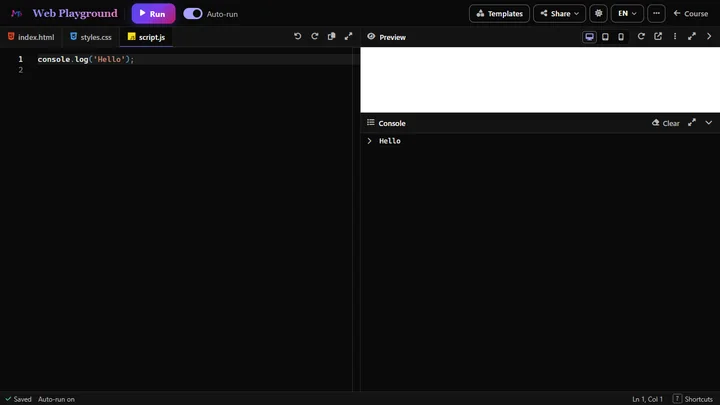
Web Playground · a browser page
JavaScript in a real page, with window and document. Output in its Console panel. Works on phones.
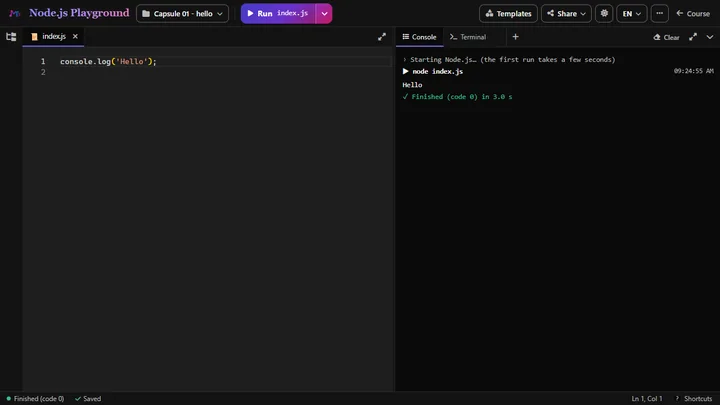
Node.js Playground · Node, inside your browser tab
Node’s environment (process, require, fs), rebuilt in your tab by WebContainers, on your browser’s own engine. Desktop Chrome or Edge.
For what a browser cannot show, later in the course.
Chapter links open the code and wait for Run, so you can predict first.